






Product Technology
Why Does Clean Brake Fluid Still Need Regular Replacement?
Many vehicle owners open the brake fluid reservoir, see that the fluid is clear and nearly the same color as new fluid, and assume there is nothing to worry about:“It still looks clean, so it does not need to be changed.”Unfortunately, this is one of the most common misconceptions in brake system maintenance.Clean-looking brake fluid is not necessarily healthy brake fluid. Its appearance alone cannot tell you how much moisture it contains or whether its boiling point has fallen below a safe level.This article explains why brake fluid replacement may still be necessary when the fluid looks clean, when it should be changed, and how to perform a proper brake fluid change.
Brake Fluid Is a Hygroscopic Hydraulic Fluid
Despite its name, the primary function of brake fluid is not lubrication. It is a hydraulic medium that transfers pressure through the braking system.When you press the brake pedal, the brake fluid transfers pressure from the master cylinder through the brake lines to the wheel cylinders or brake calipers. This pressure pushes the brake pads against the brake discs, slowing or stopping the vehicle.One of the most important technical properties of brake fluid is its boiling point—not its color.Common brake fluids include DOT 3, DOT 4, and DOT 5.1. Their dry boiling points are generally above 200°C (392°F). A higher brake fluid boiling point helps the fluid remain stable during repeated braking, high-speed braking, towing, or long downhill driving.
Clean-Looking Brake Fluid Can Still Contain Moisture
Most glycol-based brake fluids, particularly DOT 3, DOT 4, and DOT 5.1, are hygroscopic. This means that they gradually absorb moisture from the surrounding air.
Moisture may enter through the brake fluid reservoir vent, hoses, seals, and microscopic openings in the hydraulic system. This process happens slowly and usually does not produce an obvious change in the fluid’s color, smell, or appearance.
As a result, brake fluid may still look clear while its performance has already deteriorated.
Excess moisture can cause three major problems:
1. A Lower Boiling Point
Fresh brake fluid may have a dry boiling point of 230°C (446°F) or higher. As the fluid absorbs moisture, its boiling point can fall to approximately 150°C (302°F) or even lower. During repeated or heavy braking, the brake system generates considerable heat. If the brake fluid boils, vapor bubbles may form inside the hydraulic system.
Unlike liquid, vapor can be compressed. This may cause:
A soft or spongy brake pedal
Increased pedal travel
Reduced braking response
Temporary brake fade
In severe cases, partial or complete loss of braking force
2. Corrosion Inside the Brake System
Moisture can contribute to corrosion inside brake lines, calipers, wheel cylinders, the master cylinder, and ABS hydraulic components.
Over time, corrosion may cause sticking components, internal blockages, fluid leaks, or expensive damage to the ABS pump and valve assembly.
3. Reduced Low-Temperature Performance
Brake fluid with excessive moisture and contamination may become less stable under extremely cold conditions. Increased viscosity can slow the hydraulic response of the braking system.
The key point is that a visible color change is often a delayed warning sign. Even if the fluid remains clear, its moisture content may already be too high and its boiling point may already be too low.
That is why visual inspection alone cannot determine whether a brake fluid change is necessary.
At What Moisture Level Should Brake Fluid Be Replaced?
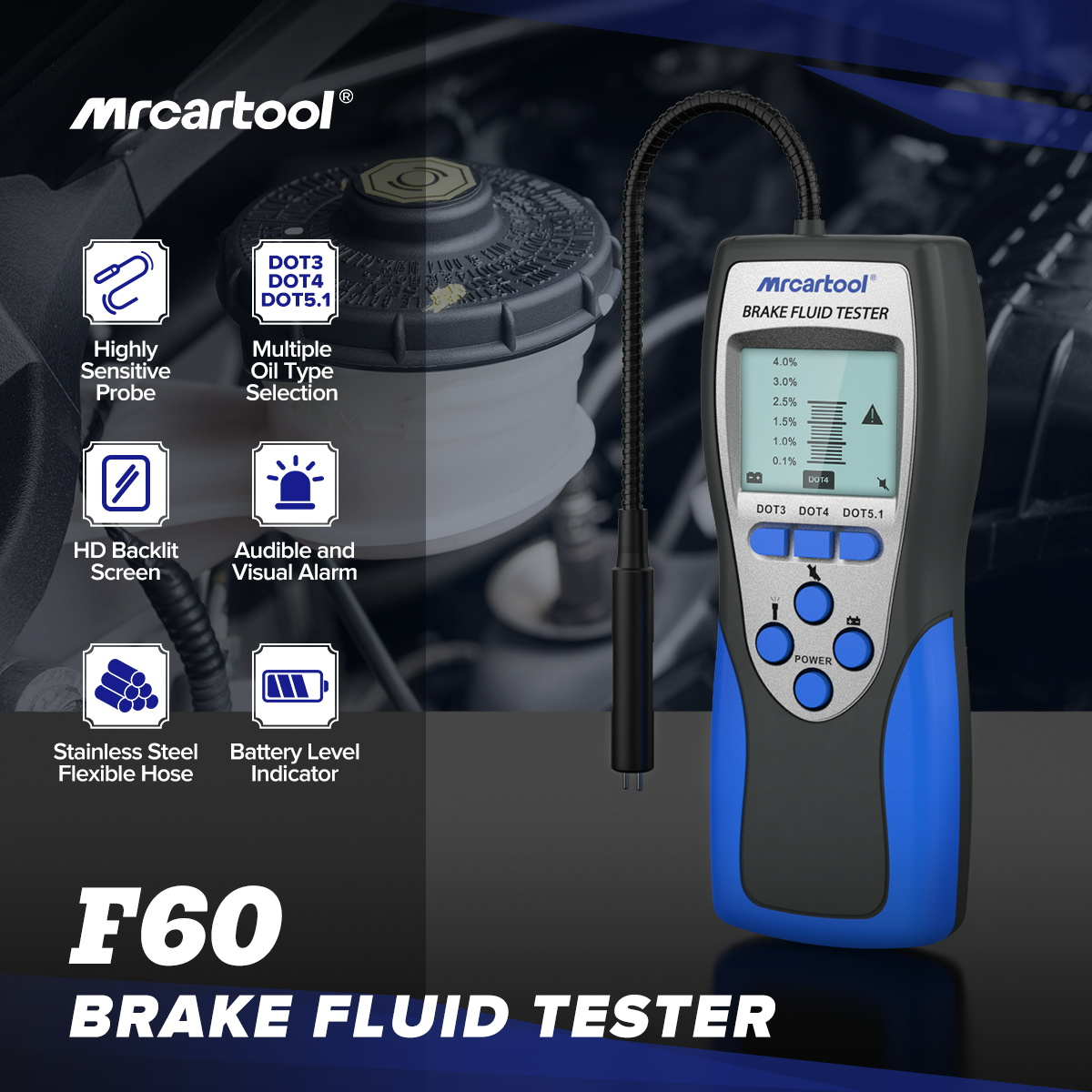
Using a professional brake fluid tester is more reliable than judging fluid condition by color alone.
The following ranges can be used as general service references:
Below 1% moisture: The fluid is generally considered to be in normal condition.
Between 1% and 3% moisture: The fluid has entered a caution range. Further inspection and timely replacement should be considered.
Above 3% moisture: Brake fluid replacement is generally recommended as soon as possible.
Above 4% moisture: The fluid may present a significant safety risk and should be replaced immediately.
These percentages are general reference values rather than universal limits. Always follow the vehicle manufacturer’s maintenance requirements and the tester manufacturer’s instructions.
Providing customers with measurable results is also more convincing than simply saying, “Your brake fluid should be changed.” Data helps technicians explain the service recommendation clearly and reduces the risk of subjective judgment.
Two Common Brake Fluid Maintenance Misconceptions
Misconception 1: “The Fluid Looks Clean, So It Does Not Need to Be Changed”
Color only reflects part of the fluid’s condition. It cannot accurately reveal moisture content or confirm that the boiling point remains within an acceptable range.
Brake fluid may still look clean after two years of use, even when it has absorbed enough moisture to affect its high-temperature performance.
Misconception 2: “I Can Just Top It Up Instead of Replacing It”
Adding a small amount of new brake fluid does not remove moisture or contamination from the old fluid. The new fluid simply mixes with the old fluid already inside the reservoir, brake lines, master cylinder, calipers, and ABS hydraulic unit. Most of the deteriorated fluid remains in the system. Topping up is also not a substitute for diagnosing the cause of a low fluid level. A low level may be related to normal brake pad wear, but it can also indicate a leak that requires immediate inspection.
A complete brake fluid replacement is the correct way to remove old fluid and restore the system with fresh fluid of the specified type.
As a general guideline, many manufacturers recommend changing brake fluid approximately every two years or 40,000 kilometers (about 25,000 miles). However, the correct interval depends on the vehicle, fluid specification, operating environment, test results, and manufacturer’s maintenance schedule.
Always refer to the vehicle owner’s manual or service information.
A Proper Brake Fluid Change Replaces Fluid Throughout the System
A professional brake fluid change involves more than removing old fluid from the reservoir and adding new fluid. The objective is to replace the old fluid throughout the master cylinder, brake lines, calipers, and wheel cylinders while removing trapped air from the hydraulic system. Simply extracting fluid from the reservoir does not replace the fluid remaining in the rest of the system.
Traditional Manual Method
The traditional method usually requires two technicians:
One technician repeatedly presses and releases the brake pedal.
The other technician opens and closes the bleeder screws at the wheels.
Old fluid and trapped air are discharged in the specified sequence.
This method can be time-consuming and physically demanding. Poor coordination or incorrect operation may also allow air to enter the brake lines.
Professional Pressure-Replacement Method
A professional brake fluid changer supplies fresh brake fluid to the reservoir at a stable, controlled pressure. Old fluid and trapped air are then discharged through the wheel bleeder screws in the correct sequence.
Depending on the vehicle and equipment, this method can allow one technician to complete the fluid replacement and bleeding process without repeatedly pressing the brake pedal or starting the engine.
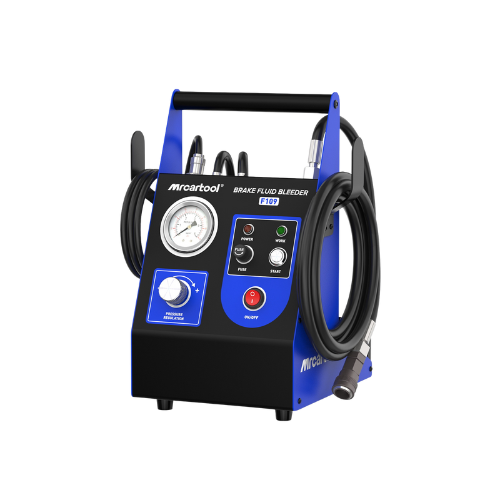
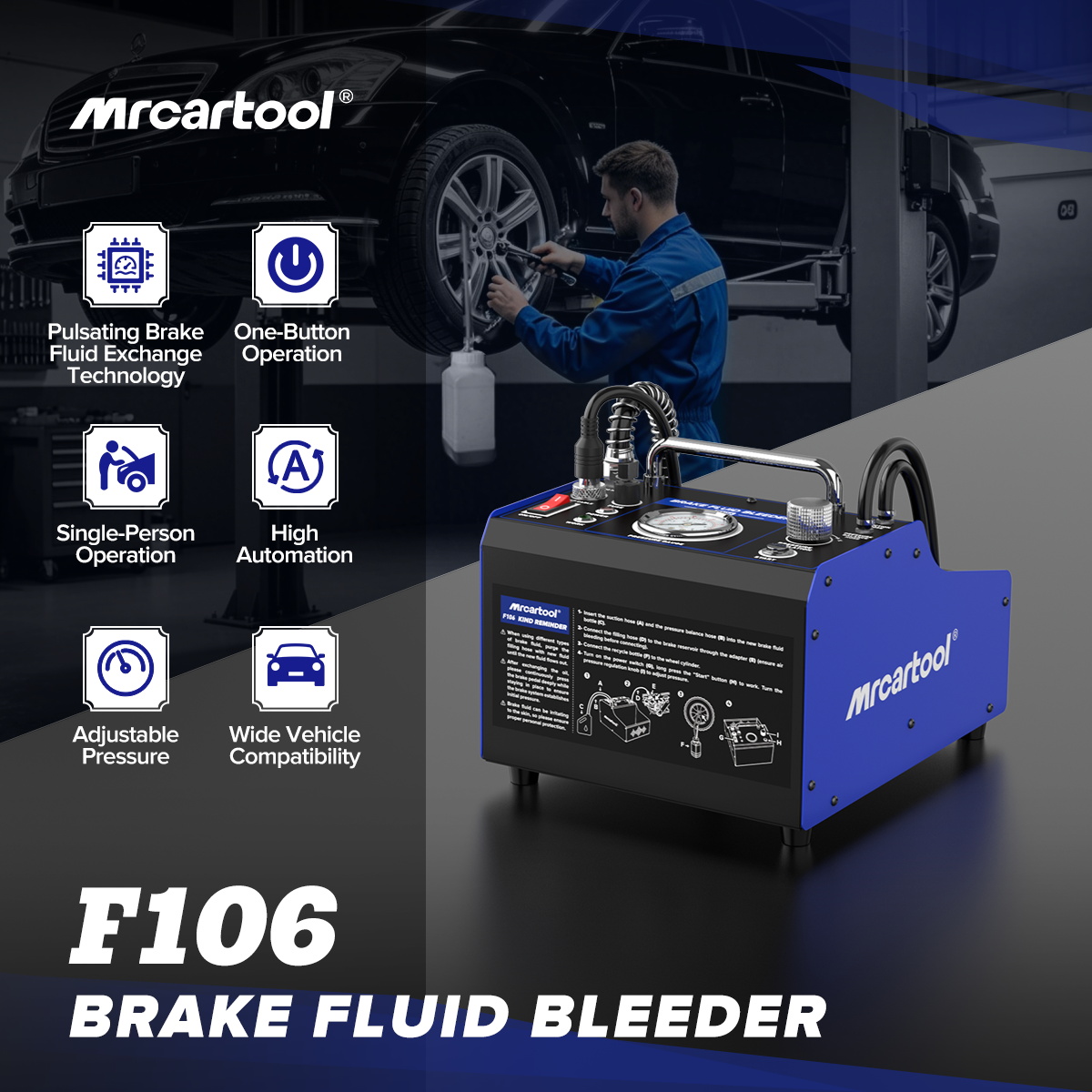
MRCARTOOL F106 Brake Fluid Changer
For repair workshops, quick-service centers, and fleet maintenance facilities, brake fluid service must be thorough, efficient, and controlled.
The MRCARTOOL F106 Brake Fluid Changer uses a pulsed fluid-replacement process to deliver fresh brake fluid to the reservoir under stable pressure. Old fluid and trapped air can then be discharged sequentially from the wheel cylinders or calipers.
This allows one technician to perform brake fluid replacement and bleeding more efficiently.
Key features of the MRCARTOOL F106 include:
Adjustable pressure: A pressure regulator and gauge allow the technician to select a suitable operating pressure according to the vehicle and manufacturer’s service requirements.
One-person operation: Repeated brake pedal operation is generally unnecessary, reducing labor requirements and service time.
Automatic shutdown when fluid is low: The machine can stop when the fresh brake fluid supply becomes insufficient, helping reduce the risk of pump dry running and air entering the brake system.
Automatic pressure release and overpressure protection: The machine releases pressure after shutdown and incorporates protective features designed to reduce the risk of excessive pressure damaging the reservoir, master cylinder, or seals.
Separate fresh- and waste-fluid circuits: Independent fluid paths help reduce the risk of cross-contamination between new and used brake fluid.
Designed for workshop use: Brake-fluid-resistant lines, a metal housing, and a carrying handle support routine movement and repeated workshop operation.
Technicians must still follow the correct bleeding sequence, fluid specification, pressure limit, and vehicle-specific service instructions
Do Not Judge Brake Fluid by Color Alone
Clear brake fluid is not necessarily brake fluid in good condition. Moisture content, boiling point, service age, operating conditions, and the vehicle manufacturer’s maintenance schedule are more valuable indicators than appearance alone.
For vehicle owners, regular inspection and proper brake fluid replacement are important parts of maintaining consistent braking performance.
For professional workshops, combining the MRCARTOOL F60 Brake Fluid Tester with the MRCARTOOL F106 Brake Fluid Changer creates a more complete service workflow. The F60 supports data-based inspection, while the F106 helps technicians replace old fluid and bleed the hydraulic system efficiently.
If your workshop needs a brake fluid service solution that supports condition testing, one-person operation, adjustable pressure, and built-in safety functions, the MRCARTOOL F60 and MRCARTOOL F106 are worth considering.
Contact us to learn more about the MRCARTOOL F60 Brake Fluid Tester and MRCARTOOL F106 Brake Fluid Changer, including product specifications, purchasing options, and current offers.
seller@Mr car tool.net
+86 189 2376 8146
