Many car owners don’t pay much attention to brake fluid, but it absorbs moisture and degrades over time. Once its boiling point drops, the brake pedal feel becomes spongy, potentially compromising safety. Therefore, Brake Pressure Bleeder regularly is crucial. Compared to the traditional two-person brake pedal pumping method, more people are using brake pressure bleeders (pressure-based replacement/bleeding tools) for more stable operation and reduced risk of air entering the system.
1.Why Change Brake Fluid?
The primary reason is that its performance degrades over time and with use, compromising braking effectiveness and driving safety. Specific causes include:
1. Reduced boiling point due to water absorption Brake fluid is hydrophilic and absorbs moisture from the air. When moisture content exceeds a certain threshold (e.g., 3.5%), the boiling point drops significantly. This can cause boiling and vapor lock during high-temperature braking, leading to brake failure. 2. Oxidation and Degradation After prolonged use, brake fluid oxidizes and degrades, darkening in color and losing performance, which impairs the transmission of braking force. 3. Impurities and Contamination Brake fluid may become contaminated with impurities or sediment, affecting its flowability and causing uneven braking force. 4. Protecting the Brake System Brake fluid may become contaminated with impurities or sediment, affecting its flowability and causing uneven braking force. 5. Ensuring System Functionality Brake fluid is the critical medium in the braking system. Regular replacement prevents safety hazards caused by performance degradation.
2. How To Determine When Brake fluid needs replacement?
Key indicators for brake fluid replacement include: scheduled replacement intervals, moisture content testing, boiling point testing, fluid condition changes, and abnormal driving symptoms. The standard replacement interval is 2 years or 40,000 kilometers (whichever comes first), but should be adjusted based on environment and driving habits. Replace when moisture content exceeds 3%; immediate replacement is required if it exceeds 4%. Also replace promptly if fluid appears cloudy or blackened, or if symptoms like soft brakes or increased stopping distance occur. For testing tools, consider our F60
1. Utilizes innovative pressure-boosted detection technology with built-in intelligent big data algorithms for stable performance and precise moisture content measurement. 2. Features a rigid flexible hose with an iron oxide outer layer, offering exceptional oxidation resistance, oil stain tolerance, and corrosion protection. 3. Covers six brake fluid types: traditional DOT series (DOT-3/4/5/5.1) and latest ENV standards (ENV4/ENV6), accommodating testing needs for all vehicle brake fluids.
3. How Many Methods Are There For Changing Automotive Brake Fluid? – Brake Pressure Bleeder
There are over five primary methods for replacing brake fluid: disassembly, pressure flushing, manual fluid exchange, vacuum extraction, and pulse pressure control. Each method has distinct characteristics in terms of operational complexity, thoroughness of replacement, and suitability for different scenarios.
Disassembly Method: Requires complete brake system disassembly for thorough replacement but is time-consuming and carries vehicle damage risk.
Pressure Flushing Method: Uses air pump pressure to expel old fluid and inject new fluid, but may leave residual old fluid in hard-to-reach areas. High residual old fluid ratio; improper pressure control can damage brake fluid lines and reservoirs.
Manual Replacement Method: Requires two to three people working together. Operators must repeatedly press the brake pedal while loosening the bleed screw. This lengthy process is prone to air ingress and necessitates bleeding after replacement, resulting in low efficiency.
Vacuum Extraction Method: Uses a vacuum pump to extract old fluid and inject new fluid. Requires multiple operators for replacement, resulting in low efficiency.
Pulse Pressure Control Method: Fully enclosed pneumatic system for automatic fluid replacement. One-button operation ensures high efficiency and precision, requiring only one operator. No additional bleeding is needed after replacement. Safe, reliable, simple, and highly efficient.
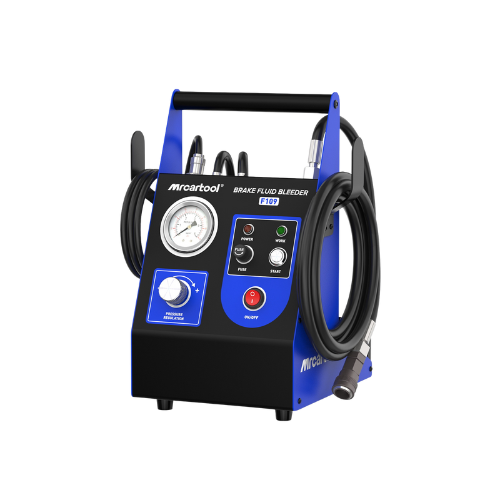
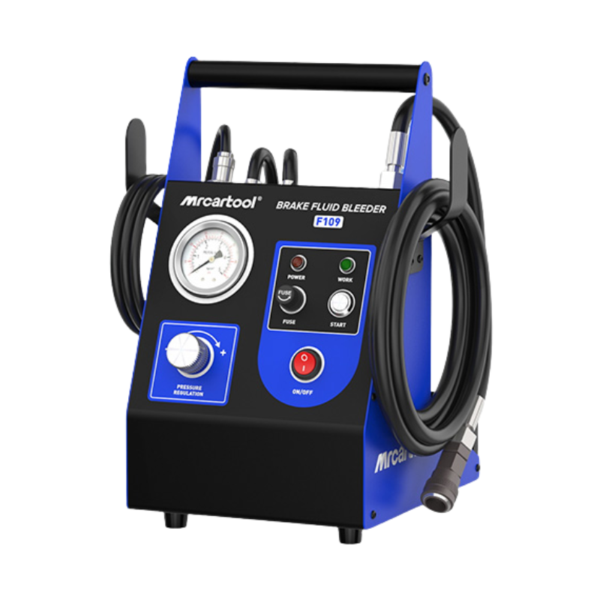
Popular models in the MRCARTOOL Brake Pressure Bleeder series include F109/F119. Equipped with a high-quality plunger pump core supply system, the MRCARTOOL Brake Fluid Replacement Machine achieves continuous and stable brake fluid output through precise pulse pressure control, completely preventing air ingress into the brake lines throughout the process. Their efficient sealed pumping design fundamentally prevents brake fade, delayed response, and other hazards caused by air ingress into the system. It also thoroughly guards against critical risks like brake failure, providing dual assurance for vehicle braking safety. This ensures the brake fluid replacement process is professional, efficient, and highly reliable. Precise Pressure Control Mechanical pressure adjustment control knob allows pressure settings to be adjusted via a dial, meeting the pressure requirements of different vehicle models. Bubble-Free Filling: Eliminates air ingress during filling, preventing bubble formation and eliminating manual secondary bleeding procedures. Automatic One-Touch Fluid Change: Single-operator efficiency saves time and effort, boosting productivity. Visual Pressure Gauge: Instantly monitors system pressure status during fluid exchange. Wide Vehicle Compatibility: Suitable for gasoline vehicles, electric vehicles, and motorcycles (motorcycle version available).
5.Summary
To maintain stable, linear, and reliable braking performance, regular brake fluid flushing is the most effective and practical maintenance method. Using a professional brake pressure bleeder, such as the MRCARTOOL F109/F118, allows for faster removal of old fluid and air bubbles, reduces the need for rework, and significantly improves brake pedal feel.
Whether for personal DIY projects or shop maintenance routines, the F109/F118 makes brake fluid replacement simpler and more efficient—a professional toolset well worth investing in.